

To ensure your battery-powered weather station delivers precise, uninterrupted meteorological data, you must establish a strict routine of sensor maintenance, battery management, and strategic positioning.
The Chemistry of Battery Selection and Lifespan
The performance of outdoor weather sensors depends heavily on the chemical composition of their power source. Standard alkaline batteries suffer from voltage drops in cold weather because their water-based electrolyte slows down, causing the sensor to lose connection or transmit weak signals. For consistent readings, lithium batteries are the optimal choice. They operate reliably in temperatures ranging from -40°C to 60°C and maintain a stable nominal voltage of 1.5V until they are nearly depleted. This prevents the gradual calibration drifts that occur when sensors are underpowered. When replacing batteries, always clean the metal contacts inside the compartment with a cotton swab dipped in isopropyl alcohol to dissolve any invisible oxidation layers that increase electrical resistance.
Sensor Calibration and Dust Management
Particulate matter, pollen, and spiderwebs accumulate on sensor casings over time, insulating the thermal probes and obstructing the humidity sensors. To clean these delicate components without causing mechanical damage, follow a precise sequence:
- Remove the sensor from its mounting bracket and bring it indoors to prevent wind damage during handling.
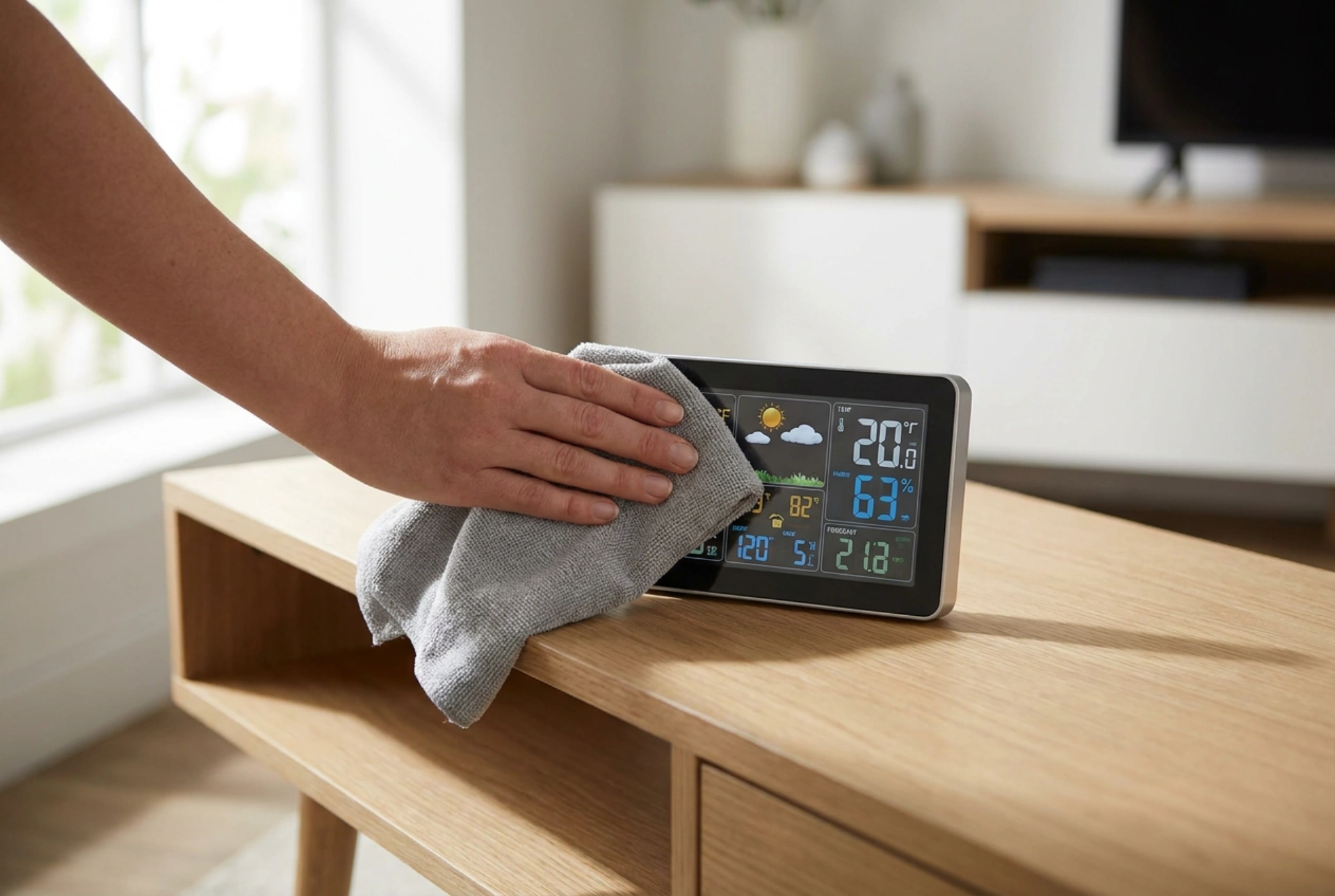
- Use a soft, dry microfiber cloth to wipe down the external housing. Avoid applying pressure to the delicate sensor grilles.
- Use a manual air blower (such as a camera lens bulb) to dislodge dust from inside the radiation shield and the humidity sensor vents. Never use compressed air cans, as the cold propellant can cause thermal shock to the delicate circuitry.
- If the plastic housing has yellowed or gathered sticky grime, wipe it down with a cloth slightly dampened with distilled water. Distilled water prevents mineral deposits from drying on the sensor grilles.
Maintaining the Rain Gauge and Anemometer
Mechanical parts require physical freedom to measure environmental forces accurately. The rain gauge, typically a tipping-bucket mechanism, relies on balance and gravity. A single leaf or a spiderweb can prevent the bucket from tipping, leading to underreported rainfall. Clean the funnel regularly and ensure the internal tipping mechanism moves smoothly without friction. Do not apply lubricants, WD-40, or grease to the anemometer or rain gauge pivots. These substances attract dust and pollen, creating a sticky paste that eventually locks the moving parts. Instead, rely on dry graphite powder if lubrication is absolutely necessary, though clean, dry plastic bearings usually perform best without any additives.
Optimizing Location and Preventing Thermal Feedback
Microclimates around your home can severely distort your weather station's readings. To capture true ambient conditions, the outdoor sensor must be shielded from direct solar radiation and thermal feedback from buildings. Mounting a sensor directly against a brick wall or under a dark roof overhang will result in artificially high temperature readings, as these materials absorb and radiate heat long after the sun has set. Position the sensor at least 1.5 meters above ground level over a natural surface like grass, rather than concrete or asphalt. If your sensor does not have a built-in solar radiation shield, you can install a passive, white louvred shield around it to allow free airflow while blocking direct sunlight.