

A crystal bedside lamp adds elegant refraction to a bedroom, but dust accumulation and improper bulb positioning can quickly turn beautiful sparkle into harsh, uncomfortable glare.
The Physics of Crystal Refraction and Glare
Crystal glass contains metal oxides, typically lead or barium, which increase the material's refractive index. This molecular structure allows the glass to bend light more sharply than standard window glass, splitting it into spectral colors. However, when dust settles on these faceted surfaces, it acts as a diffusing barrier. Instead of clean, directed refraction, the light scatters unpredictably in all directions, creating a hazy, high-contrast glare that strains the eyes in a dark room. Keeping the facets optically clear ensures that light bends along its intended path, preserving both illumination and visual comfort.
The Step-by-Step Cleaning Technique
To restore the refractive properties of the crystal without causing damage or leaving residue, follow a systematic cleaning process. Avoid harsh household spray cleaners, which can leave a microscopic film that attracts dust.
- Preparation: Disconnect the lamp from the wall outlet. Remove the light bulb and set it aside. If the crystal elements or drops are detachable, carefully remove them and lay them on a soft towel.
- The Cleaning Solution: Prepare a mixture of lukewarm water and a few drops of mild, neutral dish soap. For an optimal streak-free finish, mix in one part isopropyl alcohol to three parts water. The alcohol lowers the surface tension of the water, accelerating evaporation and preventing water spots.
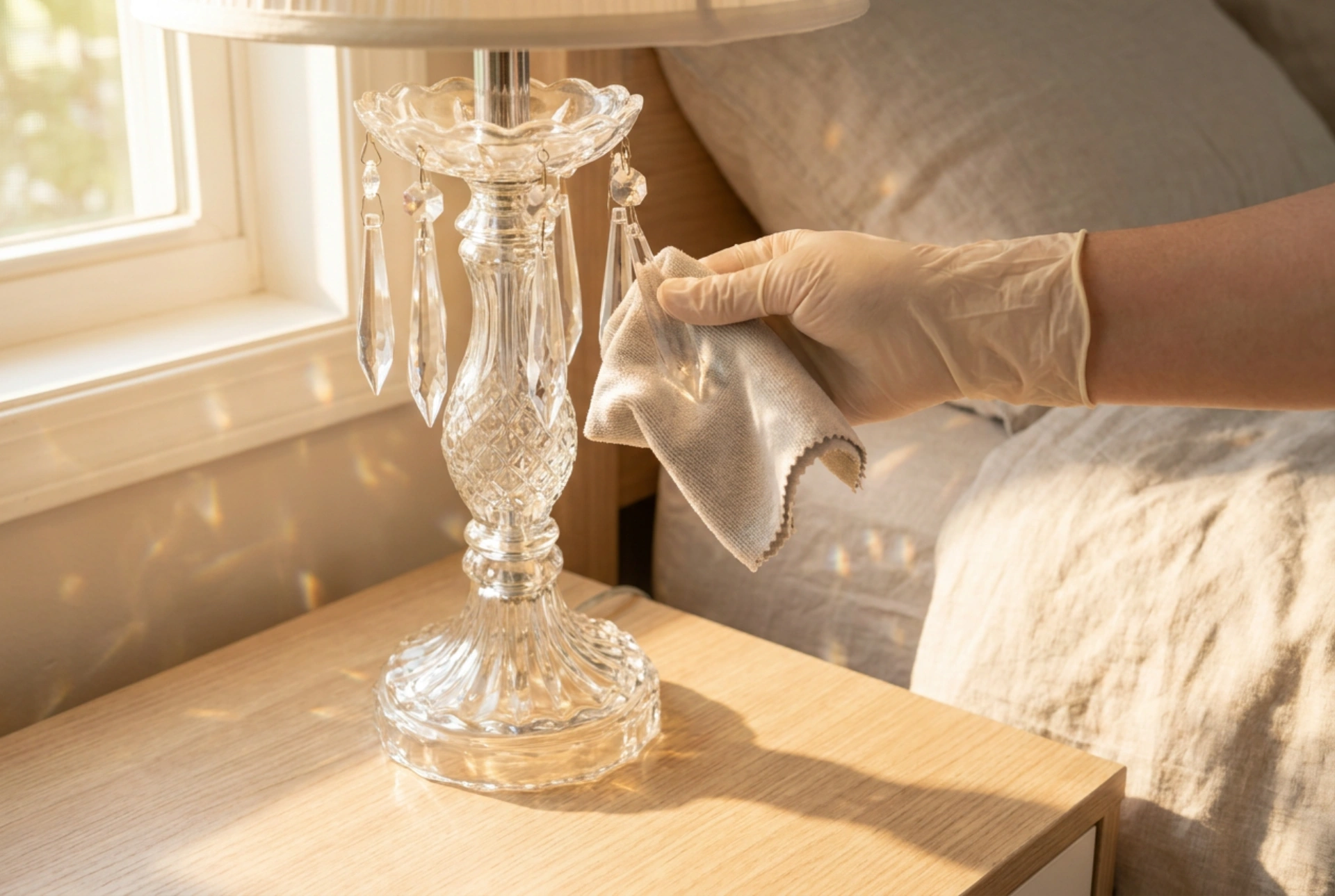
- Wiping and Polishing: Wear clean, lint-free cotton gloves. Dip a microfiber cloth into the solution, wringing it out until it is barely damp. Wipe each crystal facet individually, working from the top of the lamp downward to avoid redepositing dust. Use a second, dry microfiber cloth to polish the crystal immediately after damp wiping.
- Reassembly: Allow all components to air-dry completely for at least one hour before reattaching them to ensure no moisture remains near the electrical sockets.
Strategic Positioning for Optimal Light Distribution
Positioning a bedside lamp is a matter of geometry. To prevent direct glare while reading or resting, the bottom of the lampshade or the lowest crystal element should sit at eye level when you are sitting upright in bed. This height typically ranges between 50 and 65 centimeters above the mattress surface. If the lamp sits too high, the bare bulb will expose your eyes to direct filament glare; if it is too low, the light pool will be too narrow to illuminate your reading material effectively.
Choosing the Right Bulb and Diffusion
The type of light source inside a crystal lamp dictates how the glass facets interact with the room. Clear filament bulbs produce sharp, distinct rainbow patterns on the walls, but they can be intense. Frosted bulbs diffuse the light source before it reaches the crystals, softening the output and reducing high-contrast glare. For a bedside environment, opt for a bulb with a warm color temperature (2700 Kelvin) and a lower lumen output. Additionally, installing a physical diffuser disc inside the top of the shade or choosing a lamp with an opaque inner fabric sleeve allows the crystal elements to catch the light from the sides while shielding your eyes from direct, upward-pointing light paths.