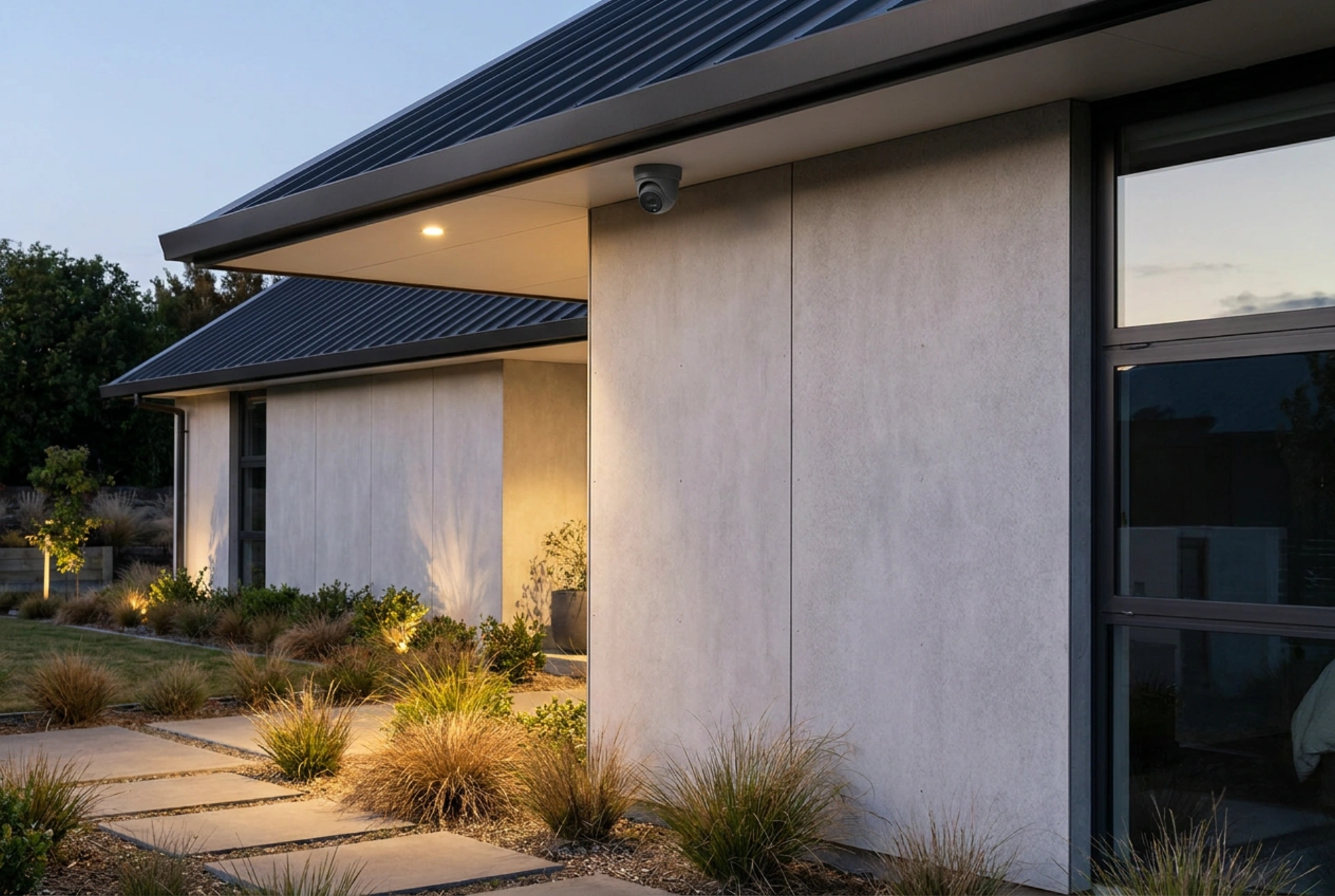


Selecting the right outdoor surveillance hardware requires matching the physical architecture of your property with the specific mechanical capabilities of the camera.
The Mechanical Advantage of Pan-Tilt Mechanics
Standard fixed-lens cameras offer a static field of view, typically restricted to an angle of 90 to 110 degrees. While sufficient for narrow entryways, they create significant blind spots on expansive properties. A pan-tilt (PT) camera utilizes internal stepper motors to rotate the optical lens horizontally (pan) and vertically (tilt). This mechanical freedom allows a single unit to cover up to a full 360-degree horizontal sweep and a 90-degree vertical arc, effectively replacing the coverage area of three individual static cameras.
This active rotation is particularly valuable for monitoring dynamic perimeters where the direction of interest changes throughout the day. By utilizing pre-programmed patrol routes, the camera can automatically sweep between designated focal points, such as a driveway, a side gate, and a tool shed, ensuring comprehensive coverage without physical gaps.
Optimal Property Layouts for Rotating Cameras
Pan-tilt cameras deliver the highest return on investment when mounted in specific structural configurations where wide-angle viewing is a necessity:
- Corner Mounts on Large Buildings: Placing a rotating camera on the external corner of a house or garage allows it to monitor two perpendicular walls and the surrounding open spaces simultaneously.
- Wide Open Spaces: Properties with sprawling lawns, long driveways, or unpartitioned backyards benefit from the panning function, as there are no physical obstacles to block the line of sight.
- Centrally Located Structures: Mounting a unit under the eaves of a centrally positioned gazebo, carport, or patio provides a complete radial view of the entire surrounding garden.
Wi-Fi Connectivity and Power Infrastructure
The integration of Wi-Fi technology simplifies the installation process by eliminating the need for long, intrusive Ethernet cabling run from the home router to the exterior walls. However, the physical laws of radio wave propagation must be considered. High-frequency 2.4 GHz and 5 GHz signals degrade when passing through dense building materials such as brick, concrete, and reinforced steel. When choosing a Wi-Fi camera, verifying signal strength at the exact mounting location is critical before drilling holes.
While data transmission is wireless, these motorized units require a stable power supply to drive the pan-tilt motors and infrared night-vision LEDs. This is typically achieved via a low-voltage DC cable routed through the wall to an indoor power outlet. For true installation flexibility, some models utilize high-capacity rechargeable batteries coupled with a small, dedicated solar panel, exploiting photovoltaic conversion to maintain a continuous charge cycle without mains wiring.
Understanding Intelligent Tracking and Detection
Modern pan-tilt cameras do not just rotate blindly; they utilize onboard edge-computing algorithms to detect movement. When a thermal signature or pixel disruption matches the profile of a person or vehicle, the camera’s processor calculates the vector of movement. It then sends real-time commands to the stepper motors to track the target across the property.
This active tracking ensures that a moving subject remains in the center of the frame, capturing high-detail facial features and license plates that would otherwise be lost at the periphery of a static lens. Once the target leaves the detection zone, the camera automatically returns to its default home position, ready for the next event.