

Setting up a laundry station in a confined layout requires careful calculation of structural loads, vibrational physics, and thermodynamic ventilation. Optimising this small footprint ensures long-term appliance efficiency, prevents moisture damage to cabinetry, and minimises structural noise transfer throughout your living space.
The Physics of Stacking: Gravity and Dynamic Loads
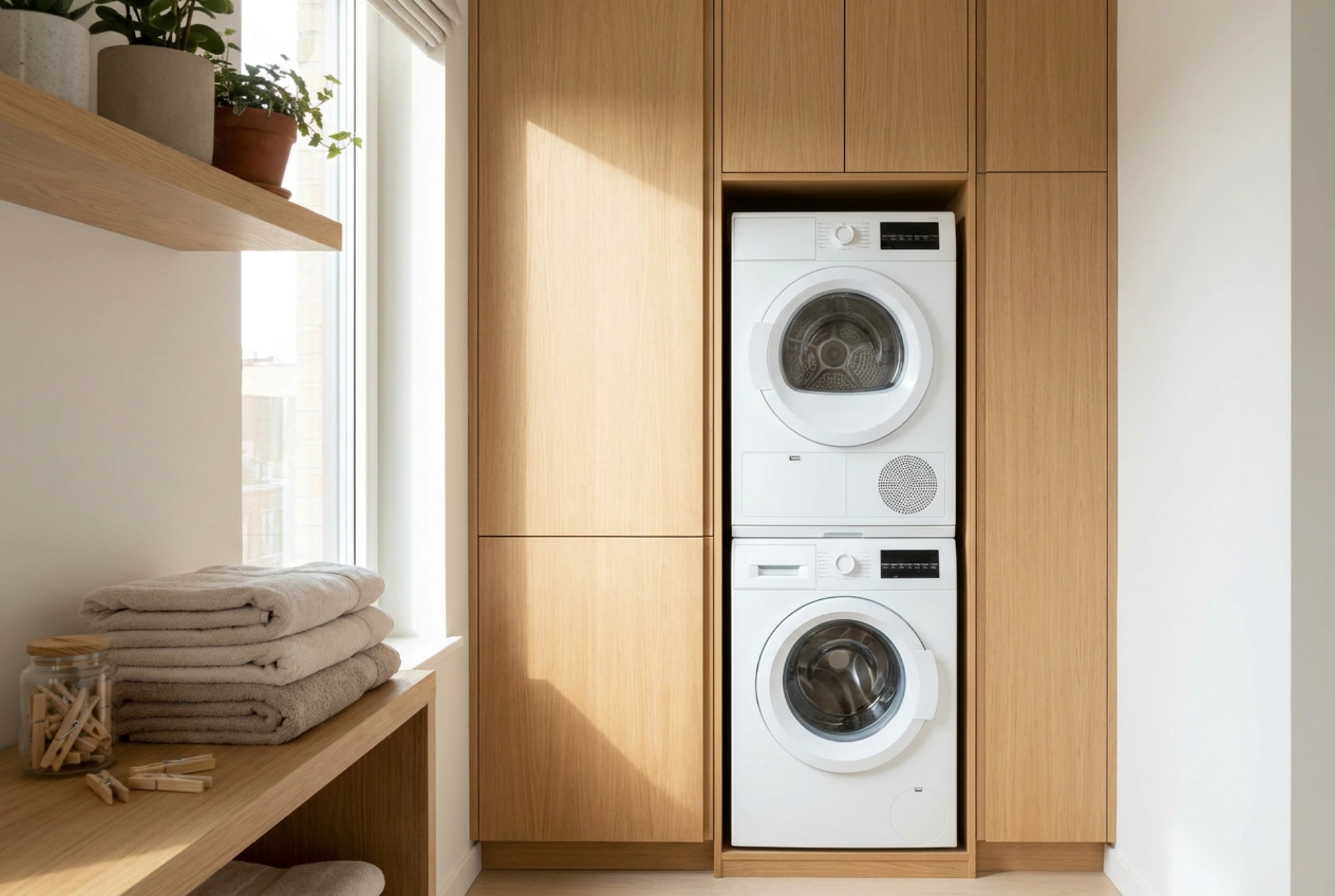
When vertical space is the only option, stacking a tumble dryer on top of a washing machine is the standard configuration. However, this arrangement must respect basic mechanical principles. The washing machine must always serve as the base unit. Washing machines contain heavy concrete counterweights—often weighing between 30 to 50 kilograms—designed to stabilise the violent kinetic forces generated during the spin cycle (typically 1200 to 1600 RPM). Placing the lighter tumble dryer at the bottom would lead to structural failure under these extreme centrifugal forces.
To couple these appliances safely, a dedicated stacking kit is mandatory. This structural frame distributes the dryer’s weight evenly across the load-bearing outer chassis of the washing machine rather than its delicate top cover. Furthermore, the kit counters the effects of resonance. When the washing machine spins, it generates harmonic vibrations; without a secure, shock-absorbing coupling interface, friction would cause the top appliance to shift, risking a catastrophic fall. High-density elastomer dampening pads should be integrated within the kit to convert this kinetic energy into negligible thermal energy, isolating the noise.
Thermodynamic Demands: Airflow and Condensation
Appliances operating in enclosed spaces, such as closets or alcoves, are subject to strict thermodynamic laws. Tumble dryers operate by heating air to evaporate moisture from fabrics. Heat pump dryers use a closed-loop refrigerant system to condense moisture, making them highly energy-efficient and less prone to releasing warm, damp air. Condenser dryers, on the other hand, expel a significant amount of latent heat into the surrounding environment.
Without adequate air exchange, the ambient temperature in a small utility closet will rapidly rise. When the surrounding air exceeds 35°C, the dryer’s heat-exchange efficiency drops drastically because the temperature differential required for condensation decreases. This forces the compressor to work harder, increasing energy consumption and potentially triggering thermal overload cut-outs. To prevent this, custom cabinetry must feature a dedicated ventilation pathway—ideally a lower intake grille and an upper exhaust vent, providing at least 200 square centimetres of unrestricted airflow to facilitate natural convection.
Spatial Clearance and Ergonomics
Accurate spatial planning goes beyond measuring the raw width and depth of the appliances. A standard washing machine requires a minimum of 2 to 3 centimetres of clearance on either side to prevent the cabinet walls from acting as a sounding board for vibrations. At the rear, a clearance of 7 to 10 centimetres is essential to accommodate utility connections safely.
- Hose Bend Radii: Reinforced rubber inlet hoses and corrugated drain hoses must not be bent past their minimum bend radius. Kinking restricts water flow, causing inlet valves to fail and drain pumps to overheat due to excess backpressure.
- Door Swing Clearance: Ensure both appliance doors can open to at least 135 degrees. This allows for comfortable loading and unloading without obstructing the user’s movement in a tight corridor.
- Control Access: The optimal height for the uppermost control panel should not exceed 150 centimetres from the floor, preventing repetitive strain injury during daily operation.
Hydrodynamics and Anti-Siphoning Systems
Plumbing in a compact setup requires precise adherence to pressure and gravitational rules. Washing machines rely on internal pumps to expel wastewater, which must be directed into a standpipe or a sink trap. To prevent the "siphon effect"—where wastewater is drawn back into the clean drum due to pressure differences—the drain hose must rise to a height of at least 60 centimetres (but no more than 100 centimetres) before discharging. Incorporating a dedicated anti-siphon valve or a simple standpipe with an air break ensures atmospheric pressure prevents backflow, protecting your textiles from contamination.