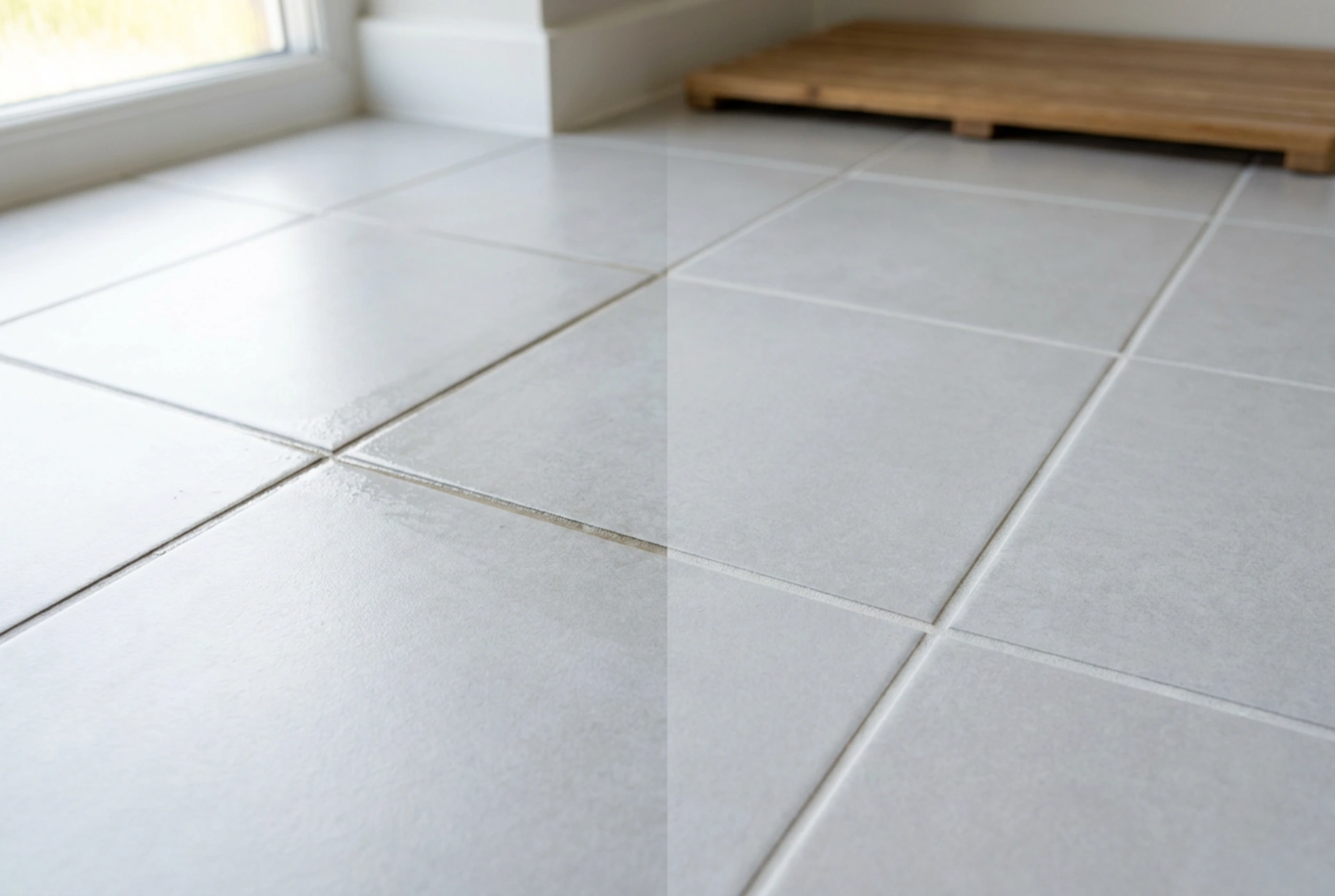


Wet-look grout sealers do not merely coat the surface; they fundamentally alter how light interacts with the porous structure of cementitious grout while forming a barrier against moisture and stains. By understanding the chemical and physical mechanisms behind these impregnators, you can achieve a durable, deep-colour finish that enhances the architectural lines of tiled surfaces.
The Physics of the Wet Look: Light Refraction and Roughness
To understand why a sealer makes grout look permanently wet, we must look at the physics of light reflection. Dry, untreated cementitious grout is highly porous and microscopically rough. When light hits this uneven surface, it scatters in every direction—a phenomenon known as diffuse reflection. This scattered light mixes with the natural pigments of the grout, making the colour appear pale, dusty, and washed out.
When you apply a wet-look impregnator, the liquid resin fills these microscopic voids and cures into a solid, smooth polymer. The refractive index of these resins (usually ranging between 1.4 and 1.6) is much closer to that of the cured cement and aggregate than air (which has a refractive index of 1.0). By replacing air in the pores with a substance of a higher refractive index, the sealer minimizes light scattering at the boundary interface. Light penetrates deeper into the grout material, where more of it is absorbed by the pigments before being reflected back to your eyes. This increased absorption and directed reflection make the grout appear richer, darker, and permanently wet.
Chemical Composition: How Impregnators Bind to Grout
Unlike topical sealers that form a thick, vulnerable film on top of the tile and grout, penetrating impregnators work within the material’s capillary network. The formulation typically consists of active polymeric ingredients suspended in either a water-based or solvent-based carrier liquid.
- Solvent-based carriers: These formulations utilize organic solvents with low surface tension. This allows the active ingredients to penetrate deeper into extremely dense grout lines or natural stone pores.
- Water-based carriers: These use water to transport the polymers. They have lower volatile organic compound (VOC) levels and are easier to apply in poorly ventilated areas, though their penetration depth can be slightly less than solvent-based equivalents on highly dense materials.
The active ingredients are typically modified acrylic polymers, fluorochemicals, or siloxanes. As the carrier liquid evaporates, these polymers undergo a curing process, cross-linking to form a semi-permanent bond with the silicates in the cement. This network does not seal the grout completely hermetically; instead, it remains vapour-permeable (breathable), allowing moisture trapped behind the tiles to escape as vapour while preventing liquid water from entering.
Application Techniques for a Flawless Finish
Achieving a uniform wet-look finish requires precise execution and a strict adherence to material science principles. Any deviation can lead to patchiness or a hazy residue on the tiles.
First, the grout must be completely dry. If water occupies the pores, the hydrophobic sealer cannot penetrate, resulting in a superficial bond that will quickly peel or turn cloudy. A minimum drying time of 24 to 48 hours after washing the tile is recommended. Second, the sealer must be applied using a firm, repetitive motion with a dense foam applicator or a natural bristle brush. This physical action forces the liquid deep into the capillaries, displacing trapped air. Finally, any excess sealer on the glaze of the tiles must be completely buffed away within 10 to 15 minutes of application. Once cured, the polymer resins become highly chemical-resistant, making dried residue extremely difficult to remove without specialized solvents.
Long-Term Maintenance and Chemical Resistance
The longevity of the wet-look effect depends heavily on how the surface is cleaned. Strong acidic cleaners break down the polymeric bonds of the sealer, quickly stripping away both the protective barrier and the colour enhancement. Highly alkaline cleaners can also degrade the acrylic resins over time. To preserve the molecular structure of the cured impregnator, always use pH-neutral maintenance cleaners. These clean the surface without disrupting the hydrophobic polymer network embedded within the grout lines.