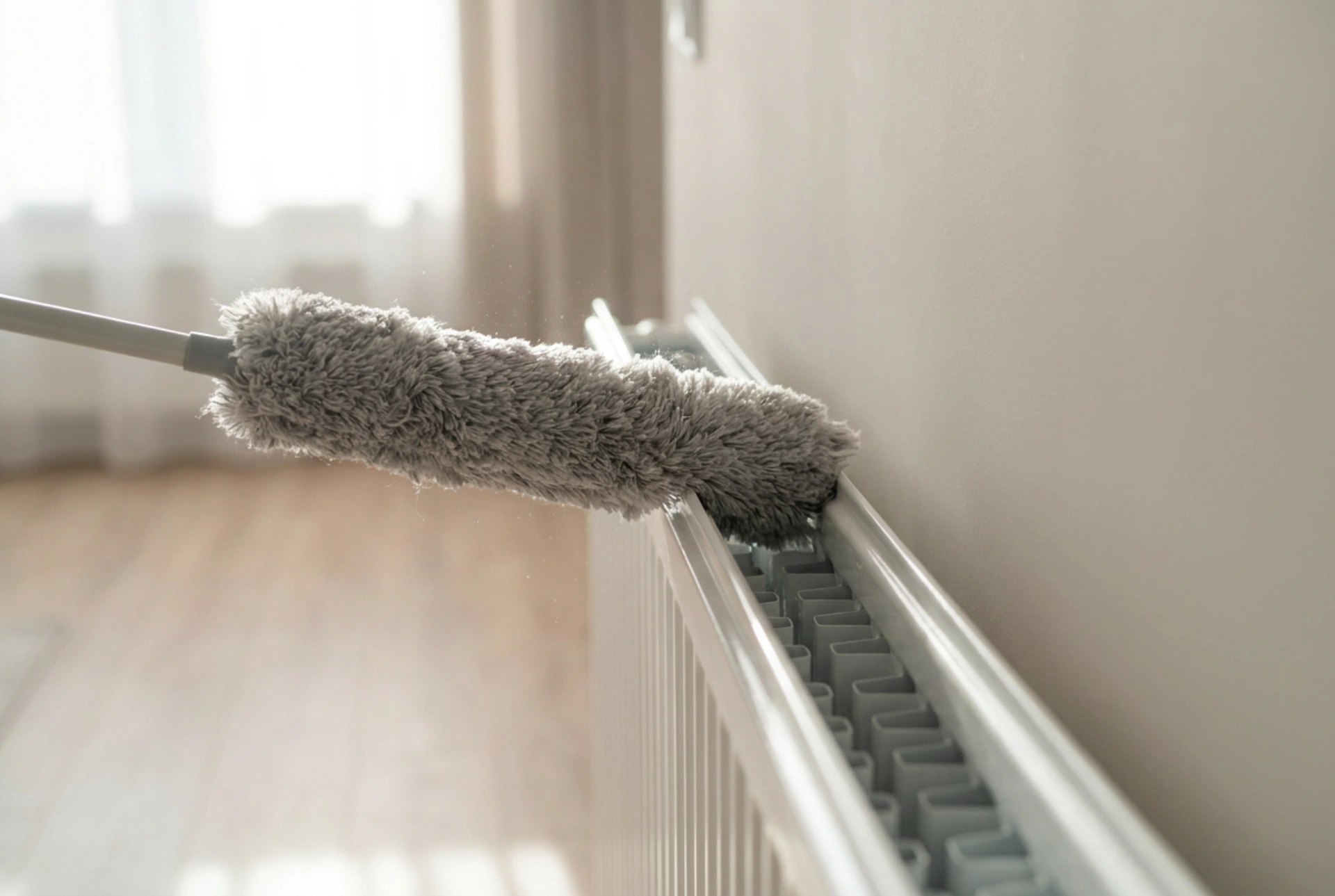


Cleaning panel and column radiators often disperses fine dust into the living space, triggering allergies and settling back onto surrounding walls. By understanding the physics of electrostatic charge and thermal convection, you can effectively capture this debris without launching it into the air.
The Convection Trap: Why Radiators Accumulate Dust
Radiators operate by heating the surrounding air, creating a continuous convection current. Cool air is drawn upward from the floor through the bottom of the heating element, warmed by the metal plates, and then released from the top. This constant upward draft acts as a low-velocity vacuum, pulling in hair, skin cells, and microscopic fibers. Over time, these particles adhere to the inner surfaces due to static electricity and residual moisture. If left uncleaned, this accumulated layer acts as an insulator, reducing the thermal efficiency of the appliance and forcing your heating system to work harder to maintain room temperature.
The Science of Dust Capture: Electrostatics and Adhesion
To clean these narrow spaces without scattering particles, you must rely on two physical principles: electrostatic attraction and liquid adhesion. Dry, synthetic brushes—such as those made of polyester or nylon microfiber—rely on the triboelectric effect. As the fibers rub against the metal fins, they generate a negative static charge that attracts positively charged dust particles like a magnet. However, if the dust layer is thick or greasy, electrostatic forces alone may not suffice. Introducing a minimal amount of water leverages the high surface tension of liquid, causing the dust particles to clump together and stick to the brush fibers rather than becoming airborne.
Step-by-Step Technique for Dust-Free Radiator Cleaning
Success lies in the order of operations and the speed of your movements. Rapid, aggressive brushing creates air turbulence that easily overcomes both static and gravitational forces, sending dust into your breathing zone. Follow this methodical sequence to keep the air clear:
- Isolate the Thermal Airflow: Always turn off the heating valve at least two hours before cleaning. If the radiator is warm, the rising warm air will immediately carry any dislodged dust upward into the room, defeating the purpose of your tools.
- Create a Gravitational Trap: Place a damp, lint-free cotton sheet or towel directly beneath the radiator. Any heavy particles that escape the brush will fall downward and instantly bind to the wet fibers of the towel, preventing them from bouncing off the floor and becoming airborne.
- Prepare the Brush: Lightly mist your flexible microfiber radiator brush with plain water or a mild, diluted surfactant. The brush should feel barely damp to the touch—never dripping wet, which could encourage rust on non-galvanised steel surfaces.
- Execute Controlled, Linear Strokes: Insert the brush slowly from the top of the radiator. Use a deliberate, downward-only motion. Avoid rapid sawing movements; instead, pull the brush straight down to the floor. The damp towel underneath will catch any dislodged debris that falls.
- Clean the Tool Frequently: After every two or three passes, vacuum the brush head using a vacuum cleaner with a HEPA filter, or rinse it in a bucket of warm water and wring it out completely before continuing. This maintains the brush's capacity to absorb more particles.
Optimising Air Quality and Thermal Output
By removing the insulating layer of dust from the internal heat-exchange fins, you directly improve the convective heat transfer coefficient of the radiator. This simple physical maintenance ensures that your heating system runs efficiently, consuming less energy to achieve the desired room temperature while significantly lowering the concentration of airborne particulate matter in your home.