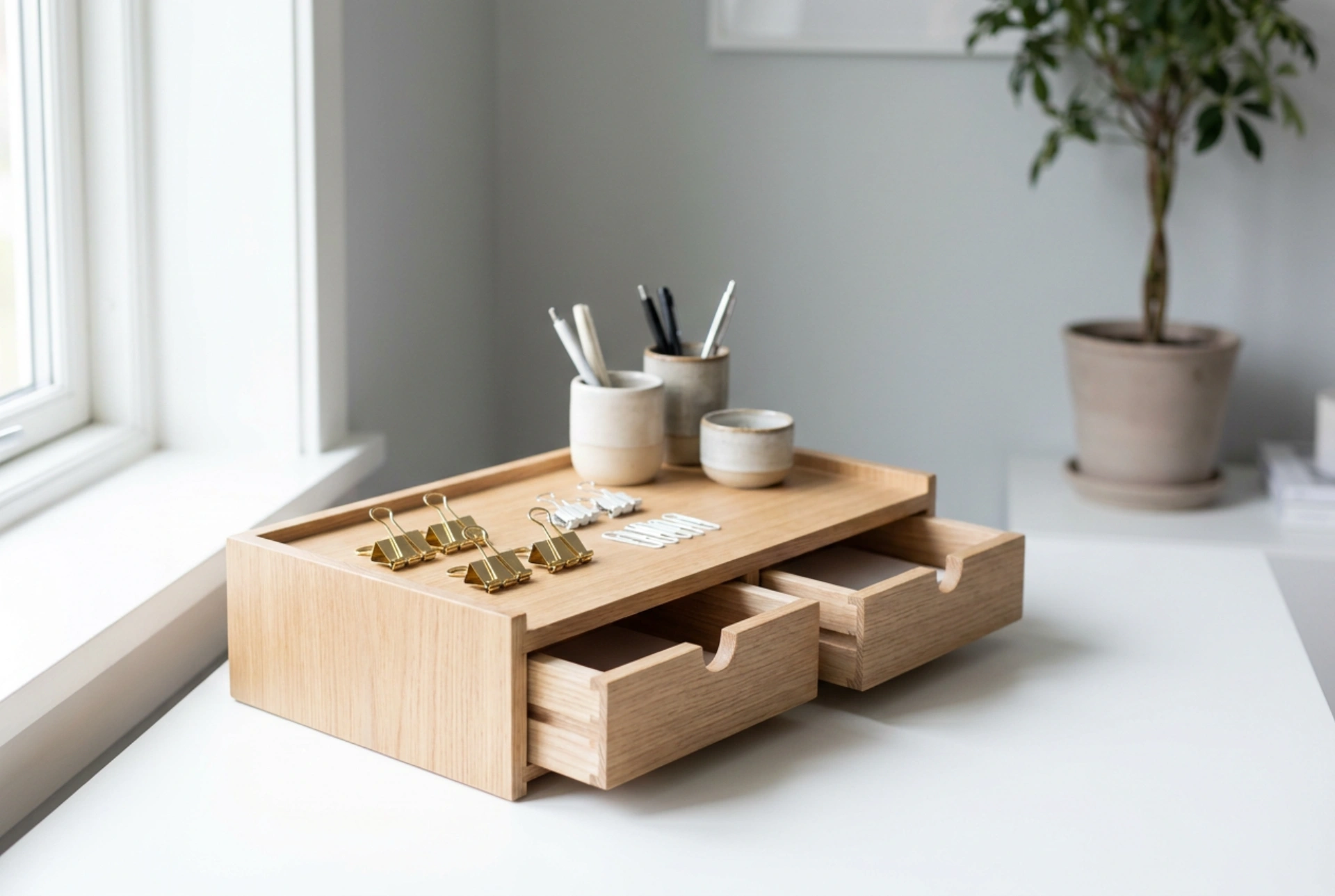


Managing small desktop items requires more than just sweeping them into a drawer; it demands a systematic approach based on physical access patterns and micro-categorisation. Using a desk organiser with drawers allows you to exploit vertical space, protect sensitive components from dust, and establish a frictionless workflow in your home office.
The Physics of Desktop Entropy and Micro-Categorisation
Small items like paperclips, safety pins, USB drives, and memory cards have high surface-area-to-volume ratios, making them prone to scattering across flat surfaces. When left loose on a desk, these objects are subjected to random physical displacements from hand movements, paper shuffling, and air currents. This accumulation of disorder is a classic representation of entropy in a closed environment.
To counteract this, drawer-based organisers introduce rigid physical boundaries. Unlike open trays, drawers prevent horizontal displacement and eliminate visual clutter, which reduces cognitive load. To maximise this setup, micro-categorisation is essential. Grouping items by precise function and material composition prevents chemical interactions (such as rubber bands degrading and fusing with plastic casings) and ensures that every object has a designated, predictable coordinate in three-dimensional space.
Material Properties: Selecting and Maintaining Your Organiser
The physical material of your desk organiser dictates its longevity, weight distribution, and maintenance needs. Understanding these material science principles helps you maintain a pristine workspace:
- Natural Wood: Wooden organisers offer structural stability and natural weight, preventing the unit from sliding when drawers are pulled. However, wood is hygroscopic, meaning it absorbs and releases moisture from the air. Keep wooden units away from direct sunlight and humidifiers to prevent warping. Clean with a dry or slightly damp microfibre cloth along the grain.
- Acrylic and Plastics: These materials are lightweight and offer excellent visibility, but they are highly susceptible to static electricity, which attracts airborne dust. Wipe acrylic drawers with an anti-static formulation or a highly diluted mixture of water and a mild non-ionic surfactant to neutralise surface charges.
- Powder-Coated Steel: Metal organisers provide maximum durability and resistance to impact. The powder coating prevents oxidation (rust). Ensure the coating remains intact; if scratched, moisture can reach the ferrous metal underneath, leading to localised corrosion.
The Ergonomic Protocol: Vertical and Depth Mapping
An efficient organiser relies on a strict order of operations based on kinetic frequency. When arranging small items in drawers, apply the principles of ergonomic reach zones and gravity:
1. The Top Drawers (High-Frequency, Low-Mass)
Reserve the topmost drawers for items you access multiple times a day, such as pens, sticky notes, or frequently used digital media. Because these drawers are closest to your natural hand level, retrieving items requires minimal joint rotation. Store lightweight items here to keep the centre of gravity of the organiser low and stable.
2. The Middle Drawers (Medium-Frequency, Specific Tasks)
Use the middle sections for tools required for specific operational phases, such as staplers, refills, or cable ties. These drawers act as transition zones, holding items that are needed only during deep-work sessions rather than quick tasks.
3. The Bottom Drawers (Low-Frequency, High-Mass)
Place heavy items, spare batteries, boxes of paperclips, and archive drives in the lowest drawers. Placing the highest mass at the bottom lowers the overall centre of gravity of the entire organiser, preventing it from tipping forward when upper drawers are fully extended.
Eliminating Kinetic Slide: Internal Friction Liners
A common failure point of drawer organisers is the "sliding effect." Every time a drawer is opened or closed, kinetic energy is transferred to the contents, causing small metal and plastic parts to slide to the back, rattle, or become tangled. To prevent this, line the bottom of each drawer with a high-friction material like silicone sheeting or wool felt. These materials absorb kinetic energy, dampening vibration and keeping items perfectly stationary, preserving your sorting system regardless of how quickly the drawer is opened.