

Storing a rotating cake stand presents a unique kitchen challenge because of its uneven weight distribution and the delicate ball-bearing mechanism concealed within its base. Proper storage is essential not just to save cupboard space, but to protect the rotational fluidity of the bearing assembly from dust, physical distortion, and grease degradation.
The Mechanics of the Rotating Base
To understand why a rotating cake stand requires specific storage conditions, one must examine its engineering. Most high-quality turntables rely on a circular track filled with steel or ceramic ball bearings. These bearings allow the upper platform to glide smoothly over the stationary base with minimal friction. However, this assembly is highly sensitive to vertical and lateral forces when not in use. Constant, uneven pressure—such as leaning the stand on its side—forces the bearings to compress against one side of the race track, leading to micro-deformations. Over time, this results in a grinding sensation or uneven rotation during cake decorating. Furthermore, the lubricant inside the bearing track can attract fine airborne particles, kitchen grease, and flour dust, which increases friction and degrades the rotation mechanism.
Horizontal vs. Vertical Storage Physics
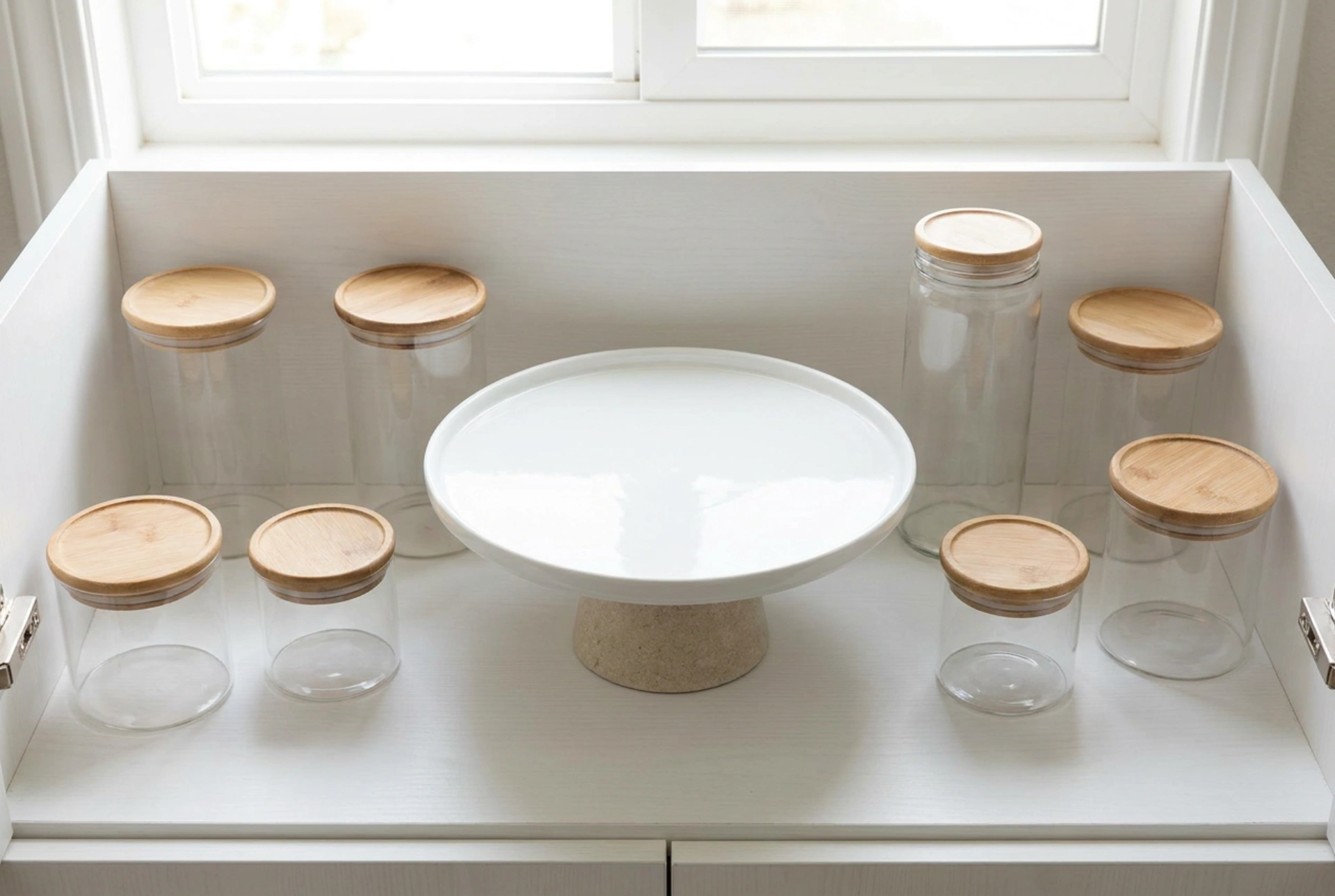
When organising your kitchen cupboards, the temptation to store flat items vertically is strong. However, storing a rotating cake stand vertically is highly detrimental. In a vertical position, the gravitational force acts parallel to the plate rather than perpendicular to it. This structural shear stress forces the central spindle to tilt slightly within its housing, causing permanent misalignment. The ideal orientation is strictly horizontal, resting flat on its base. If you must stack other baking items, never place heavy ceramic bowls or cast-iron pans on top of the turntable. Excess vertical load forces the bearings into the soft metal of the runner track, creating small divots known as brinelling. If space is limited, place the turntable on the top shelf where nothing can be stacked above it, or use a rigid shelf insert to create a dedicated clearance zone.
Surface Protection and Friction Mitigation
The materials of your turntable—whether anodised aluminium, toughened glass, or heavy cast iron—require protection from scratching and moisture. To prevent the base from slipping and to dampen vibrations within the cupboard, place a thin, food-grade silicone mat beneath the stand. This acts as a dampening barrier and prevents the base from scratching the cupboard shelf. If your stand has a glass top, cover the surface with a lint-free microfibre cloth or a felt protector. This simple barrier prevents abrasive contact with other stored items. For aluminium plates, keeping the surface dry is paramount; residual moisture trapped under a stacked item can initiate localised oxidation, ruining the smooth finish necessary for hygienic food preparation.
A Clean-Up Routine Before Storage
Before placing the cake stand into its designated cupboard space, establishing a precise cleaning routine is vital to prevent long-term material degradation. Even microscopic sugar crystals or butter residues left on the turntable can migrate into the bearing track under gravity. Sugar is highly hygroscopic; it attracts moisture from the air, creating a sticky, corrosive paste inside the housing. Always wipe the turntable with a damp microfibre cloth using lukewarm water, avoiding direct immersion in water which can drown the bearing race. Dry all components immediately with a dry cloth to prevent moisture entrapment. Once completely dry, spin the plate several times to distribute the internal grease evenly across the bearing track before placing it flat in the cupboard.
Environmental Control inside Kitchen Cupboards
Kitchen cupboards near the oven, hob, or dishwasher experience frequent fluctuations in temperature and relative humidity. High humidity levels can cause moisture to condense inside the unsealed bearing housing of the turntable, leading to rust. Elevated temperatures can also reduce the viscosity of the internal bearing grease, causing it to liquefy and seep out of the mechanism. To prevent this, designate a storage cupboard that is situated away from heat-emitting appliances. Opt for a lower shelf or a pull-out drawer where the microclimate remains cool and dry. Ensuring the cupboard is well-ventilated prevents the accumulation of stagnant, humid air, thereby preserving both the metal integrity and the lubricant efficiency of your baking equipment.