

Achieving a streak-free, non-sticky finish with a mopping robot requires understanding the chemistry of surfactants and the mechanics of automated evaporation. Unlike manual mopping, robotic systems rely on ultra-low water volume and passive drying, making the choice and dosage of cleaning agents critical to preventing residue build-up.
The Chemistry of Sticky Residues: Why Less is More
The primary culprit behind a sticky post-mop floor is an excess of surfactants (surface-active agents). Surfactants are molecules with a hydrophilic (water-attracting) head and a hydrophobic (water-repelling) tail. They work by lowering the surface tension of water, allowing it to bind to grease and lift dirt from the floor. However, because mopping robots do not perform a secondary rinse cycle, any cleaning solution applied remains on the surface. When the water evaporates, the surfactant molecules are left behind. If the concentration is too high, these molecules form a microscopic, tacky film that actively attracts airborne dust and footstep oils, compounding the stickiness over time.
The Hard Water Hazard and Mineral Streaks
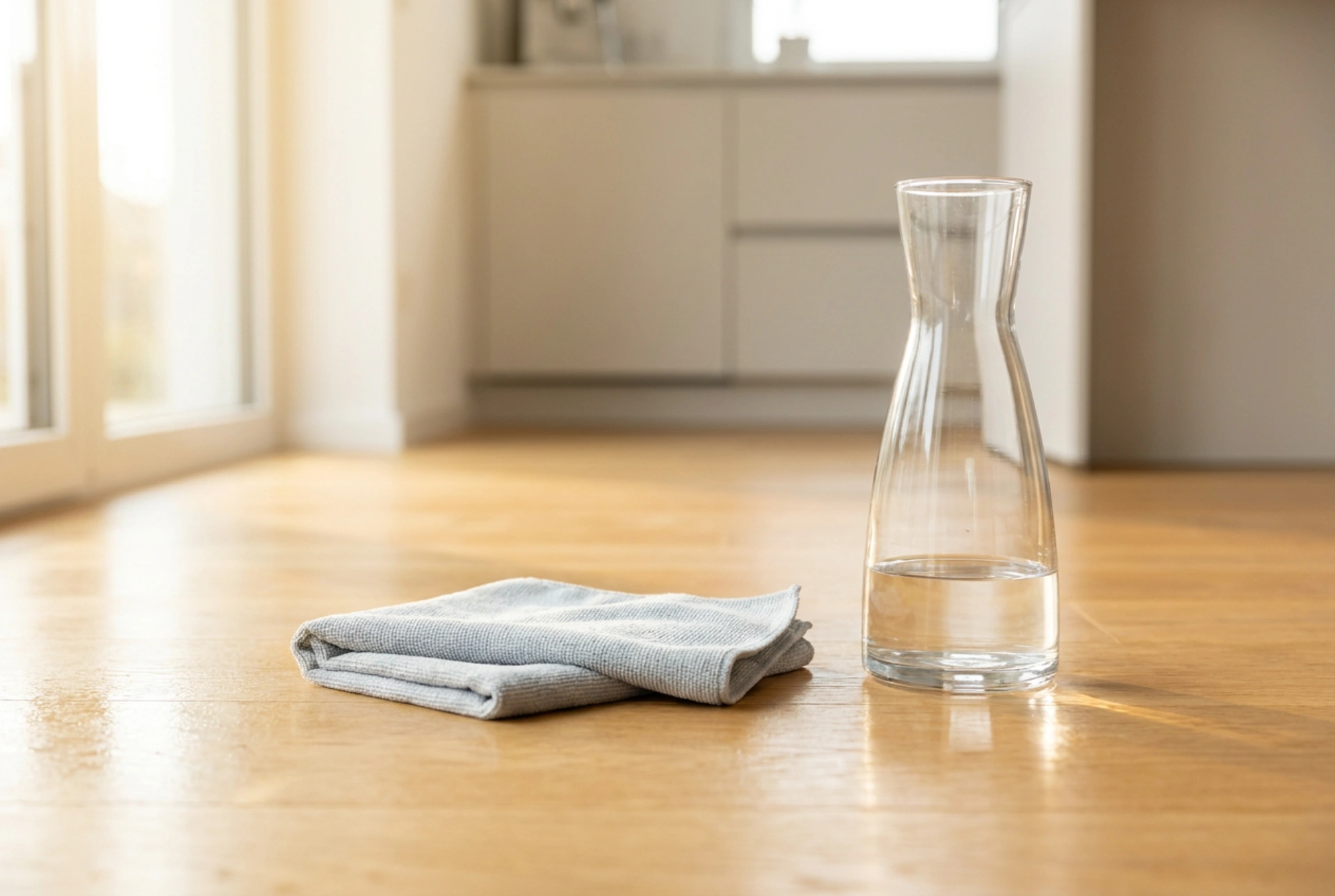
Water hardness heavily influences the visual outcome of robotic mopping. Tap water contains dissolved minerals, primarily calcium and magnesium ions. When the thin film of water left by the robot evaporates, these minerals crystallise, leaving behind faint white lines or hazy patches known as limescale streaks. Furthermore, hard water minerals chemically react with certain detergents, neutralising their cleaning power and causing them to precipitate out of solution as dulling residues. To bypass this chemical interference, using demineralised or distilled water in the robot's reservoir is highly recommended, especially in hard water regions. This ensures that the only substance evaporating is pure H2O, leaving no mineral matrix behind.
How Robot Mechanics Dictate Liquid Choice
Standard manual mopping involves a high volume of water, scrubbing friction, and physical extraction via wringing. In contrast, a robotic mop operates with a damp microfiber pad moving at a steady, low-pressure pace. The pad is designed to absorb emulsified soil, but its holding capacity is limited. Because the physical agitation is minor, the chemical agent must do the heavy lifting of breaking surface tension without creating foam. High-foaming detergents trap air bubbles that prevent the liquid from making uniform contact with the floor, resulting in uneven wetting and patchy cleaning. Therefore, any solution used must be strictly classified as a low-foaming or non-foaming formula.
The Physics of Drying: Volatility and Isopropyl Alcohol
To prevent streaks, the cleaning liquid must dry quickly and uniformly. If water pools or dries too slowly, dissolved dirt settles back onto the floor in concentrated rings. Incorporating highly volatile solvents, such as tiny, controlled amounts of isopropyl alcohol (IPA), accelerates the evaporation rate. However, caution is required: high concentrations of alcohol or harsh solvents can degrade the internal rubber seals, tubes, and plastic tanks of the robot. A safe, specialized solution should contain a highly diluted volatile solvent that balances fast drying times with material compatibility.
Practical Guidelines for a Flawless Finish
- Always under-dose: If the manufacturer recommends 5 ml of cleaning agent, start with 2–3 ml. Minimising the surfactant load is the single most effective way to eliminate stickiness.
- Use cool or lukewarm water: Hot water inside a closed plastic robot reservoir can warp components and causes volatile cleaning agents to evaporate prematurely inside the tank rather than on the floor.
- Maintain microfiber pads correctly: Wash mopping pads at high temperatures (60°C) without fabric softeners. Softeners coat the microfiber filaments in a silicone-like layer, destroying their capillary action and causing severe streaking.