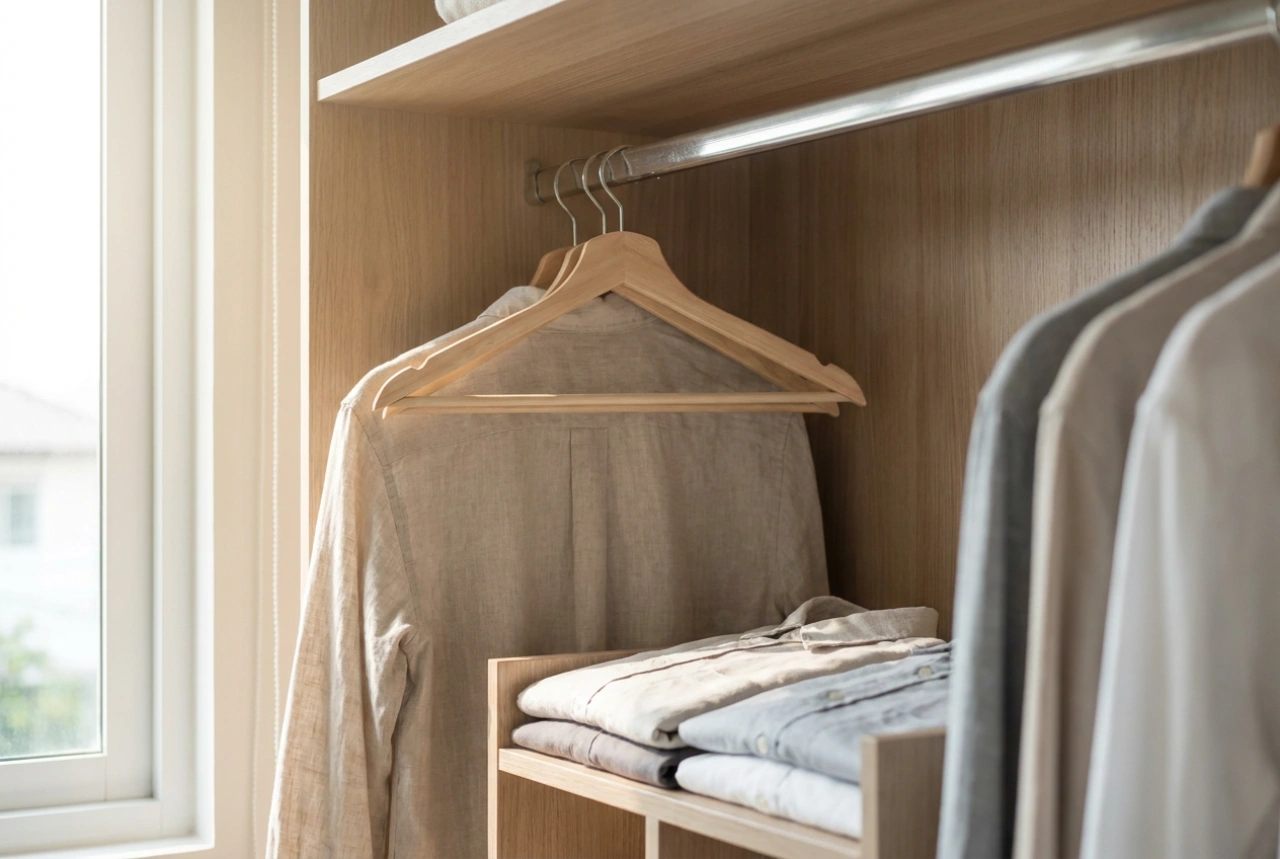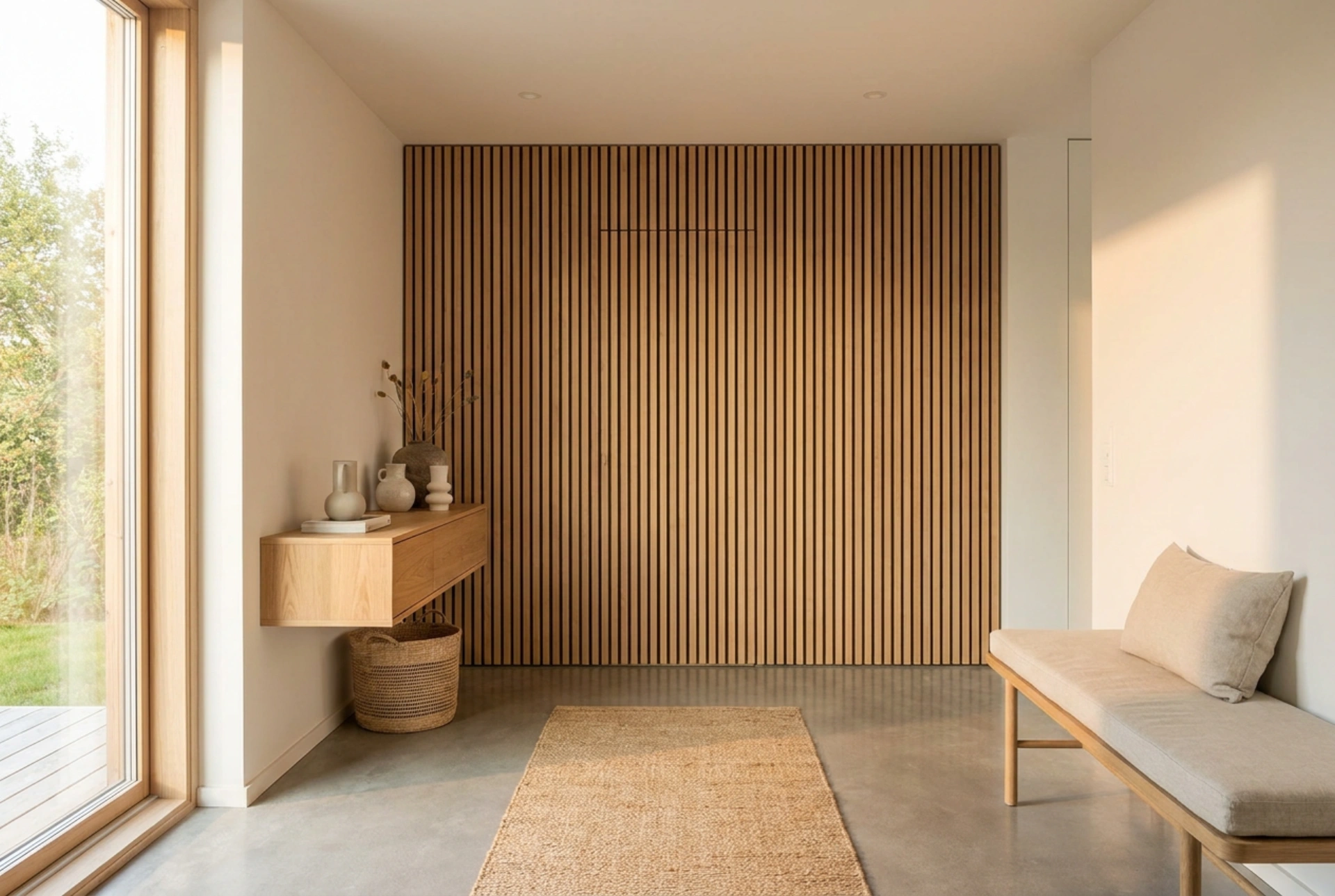


An entryway sets the tone for the entire home, yet it is often cluttered with outerwear and footwear. Integrating a hallway wardrobe behind vertical wooden slats solves this aesthetic dilemma by using structural repetition to hide storage compartments seamlessly within the wall design.
The Science of Visual Disguise: How Slatted Panels Hide Seams
The primary appeal of a slatted wardrobe lies in its ability to make doors disappear. This optical illusion relies on the human brain's tendency to prioritize pattern recognition over minor structural interruptions. When vertical wooden slats are installed with precise, uniform spacing, the shadows cast within the gaps absorb the visual seams of the wardrobe doors. For this camouflage to work, the gap between the slats must match the gap of the cabinet door joints. Usually, a spacing of 10 to 15 millimetres is optimal. Because the shadow inside the gap is dark and deep, any functional seam of a push-to-open door concealed behind the pattern becomes virtually invisible to the naked eye.
Beyond aesthetics, vertical slats improve hallway acoustics. Entryways are notoriously echo-prone spaces due to hard surfaces like tiled floors and bare walls. The undulating surface of a slatted wall acts as an acoustic diffuser. Instead of reflecting sound waves directly back into the room, the vertical grooves scatter and break up sound waves, significantly dampening the hallway's echo and creating a quieter, more welcoming entrance.
Material Science: Selecting the Right Substrate
When designing a slatted wardrobe, material selection dictates both durability and ease of maintenance. Solid wood, such as oak or ash, offers unmatched natural grain and thermal stability but can be prone to warping in high-humidity zones like entryways where wet coats and umbrellas are common. To prevent warping while retaining the beauty of real wood, veneered Medium-Density Fibreboard (MDF) is the industry standard.
- Veneered MDF: Highly stable, resistant to humidity fluctuations, and easy to cut cleanly without splintering.
- Solid Wood: Provides rich texture and depth but requires acclimation to the home's humidity levels for at least 48 hours prior to installation.
- Polyurethane Slats: Lightweight and completely waterproof, making them ideal for high-moisture zones, though they lack the authentic touch and grain of real timber.
The Mechanics of Concealed Storage
To maintain the unbroken rhythm of the wall, traditional handles must be discarded. Instead, hidden wardrobes rely on heavy-duty, spring-loaded push-to-open mechanical systems. When pressure is applied to the door, the mechanical latch releases, pushing the door open slightly so it can be grabbed by the edge.
Crucial to this setup are 3D adjustable concealed hinges. Standard hinges do not allow for the micro-adjustments needed to align slatted doors. Because even a one-millimetre deviation can ruin the vertical pattern, these specialized hinges allow installers to adjust the door along three axes: height, depth, and lateral position. Furthermore, the weight of the slatted panels must be carefully calculated. Adding wooden slats to a wardrobe door increases its weight significantly, requiring stronger hinges or a higher quantity of standard heavy-duty hinges to prevent the door from sagging over time.
Acoustics, Light, and Maintenance
The depth of the slats (typically between 10 to 20 millimetres) creates deep channels that can collect dust. Because wood and synthetic veneers can generate static electricity, they naturally attract airborne particles. To maintain the crisp shadow lines that make the camouflage successful, regular maintenance is required. When cleaning, avoid wiping horizontally, which pushes dust deeper into the recesses. Instead, use a narrow, soft-bristled brush attachment on a vacuum cleaner, moving strictly in vertical paths from top to bottom. Treating the slats occasionally with an anti-static wood polish reduces dust accumulation by neutralising surface charges.
Lighting also plays an essential role in how the slatted wardrobe is perceived. Directional overhead spotlights installed parallel to the slats cast deep, dramatic shadows that enhance the three-dimensional effect. Conversely, diffused or direct frontal lighting flattens the appearance, making the hidden door seams more noticeable. For the best camouflage effect, install warm, top-down LED strip lighting slightly offset from the wall.