

Integrating both a washing machine and a tumble dryer into a compact bathroom requires a precise understanding of spatial physics, thermal dynamics, and humidity control. Without proper planning, the combination of high moisture output and restricted airflow can lead to structural dampness, mold cultivation, and suboptimal appliance performance.
The Thermodynamics of Laundry Appliances in Confined Spaces
Every laundry cycle introduces heat and moisture into the surrounding atmosphere. While washing machines use water internally, tumble dryers—even highly efficient modern models—release a degree of warm, humid air into the room. In a small bathroom, the air volume is limited, meaning the relative humidity can rapidly reach saturation point. When this warm air contacts cold surfaces such as ceramic tiles, mirrors, or external walls, it cools down to its dew point, resulting in surface condensation.
To mitigate this, understanding the appliance technology is essential. Heat pump dryers operate as closed thermodynamic systems, extracting moisture by cooling the air inside the drum and condensing the water vapor into a collection tank. This minimizes heat and moisture emission into the room. In contrast, standard condenser dryers release more ambient heat, which accelerates evaporation but increases the ambient room temperature. Managing this thermal output requires ensuring that the bathroom’s mechanical ventilation can exchange the air volume at a rate sufficient to prevent localized humidity spikes.
Vertical Integration: Stacking Mechanics and Vibration Control
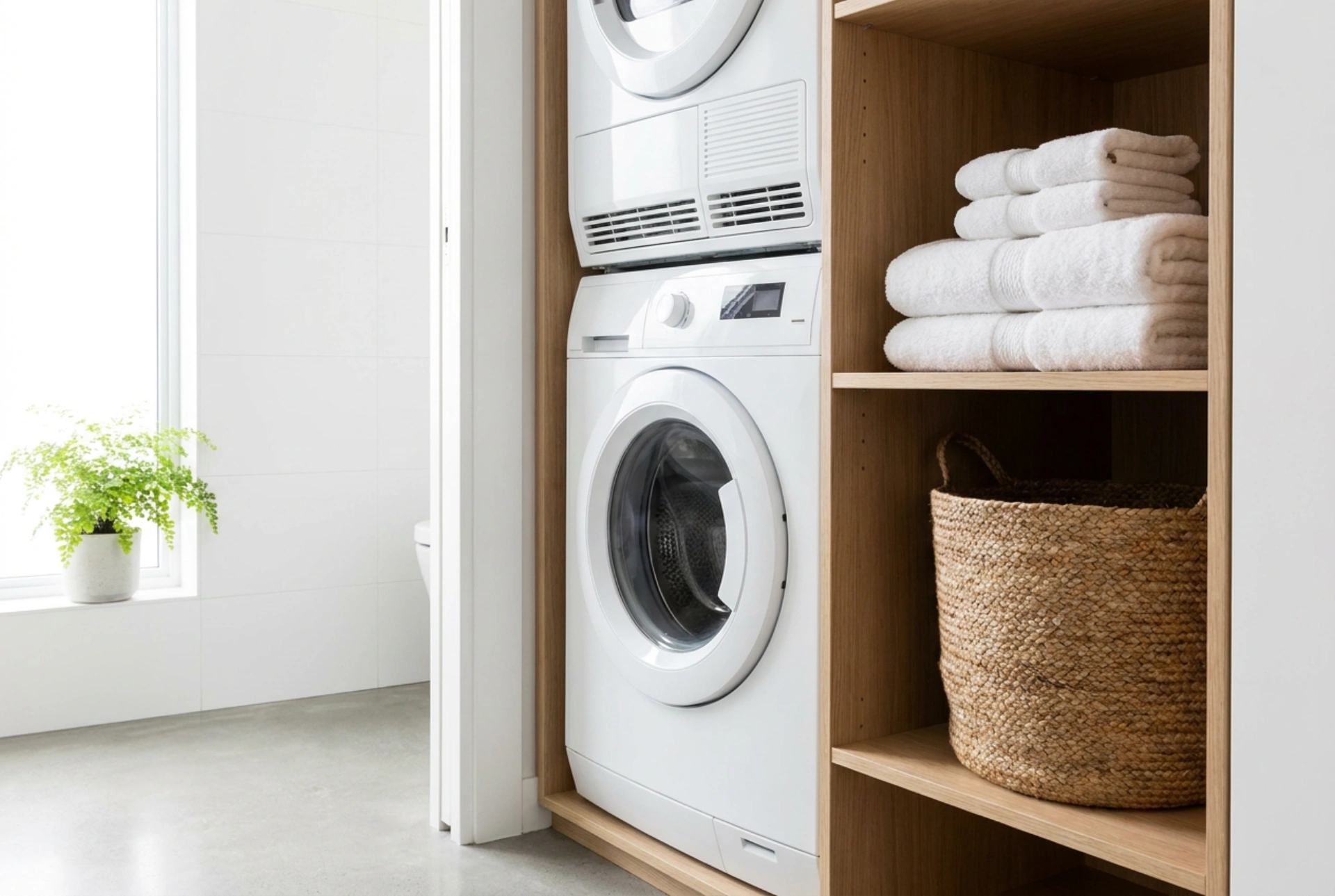
When floor space is scarce, stacking a tumble dryer on top of a washing machine is the most efficient spatial configuration. However, this vertical arrangement introduces structural and mechanical challenges, particularly during the high-speed extraction spin cycles of the washing machine. Washing machines can spin at speeds exceeding 1400 RPM, generating significant kinetic energy and lateral vibrations.
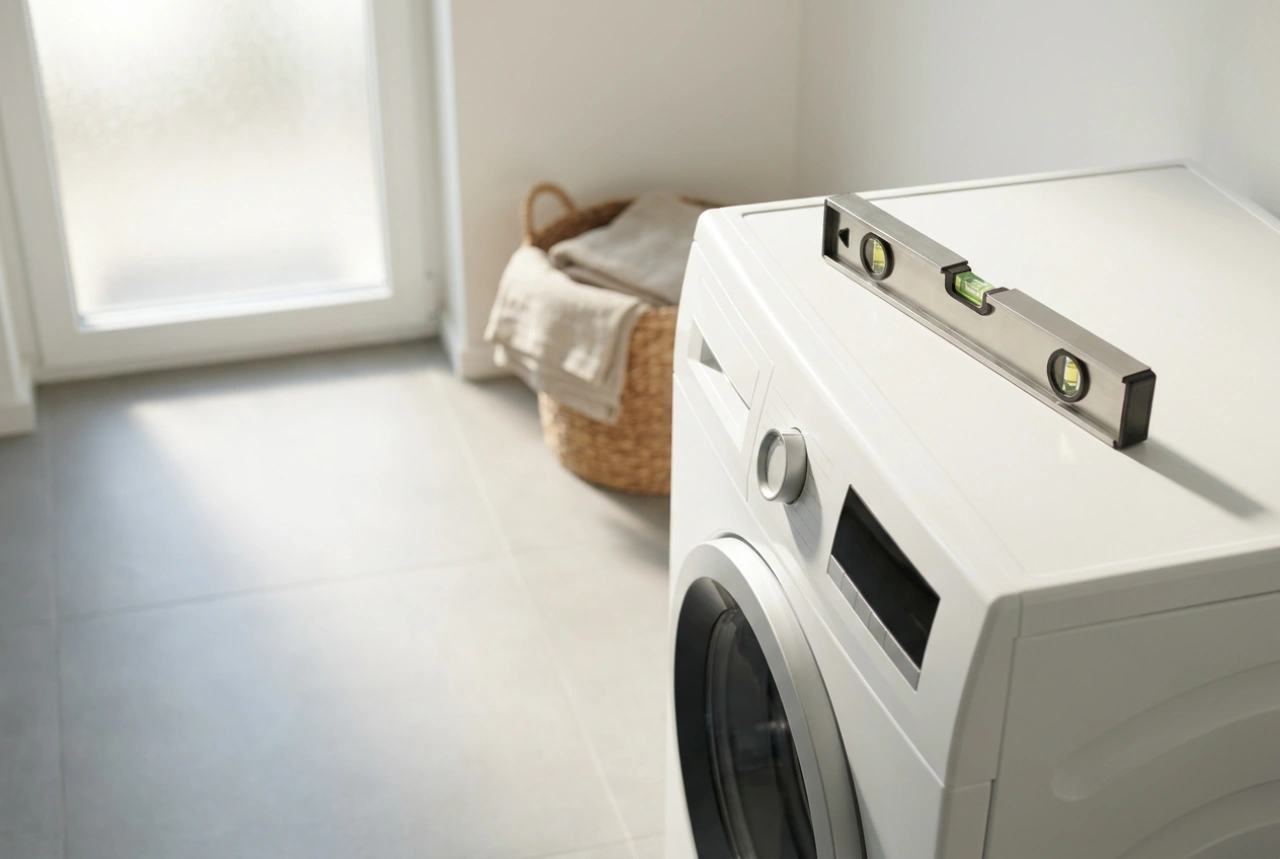
To prevent the top appliance from shifting or transferring damaging kinetic energy, a dedicated stacking kit with a tensioning strap or locking system must be utilized. The heavier appliance—almost always the washing machine due to its internal concrete counterweights—must remain on the floor to establish a low center of gravity. Additionally, high-density elastomeric dampening pads should be placed beneath the washing machine's feet. These pads absorb vibrational energy, converting kinetic motion into negligible thermal energy and preventing the resonance from transferring through the floorboards or tile adhesive, which can crack over time under constant stress.
Airflow Dynamics and Clearance Requirements
Appliances tucked into tight recesses or cabinetry must still adhere to the laws of convection. Electric motors, compressors, and heating elements require a continuous supply of cool ambient air to prevent overheating. Operating appliances in fully enclosed, unventilated cupboards restricts this airflow, forcing the cooling fans to recirculate preheated air, which severely degrades efficiency and shortens the lifespan of the electronic components.
A minimum clearance of 20 to 50 millimetres should be maintained on the sides and rear of each appliance. If the laundry column is concealed behind cabinet doors, these doors must feature louvres, grilles, or a generous undercut to facilitate passive airflow. Warm air naturally rises; therefore, providing an intake vent near the floor and an exhaust vent near the top of the enclosure utilizes natural thermal convection to draw cool air in from the bathroom floor and expel warm air safely toward the ceiling ventilation point.
Preventative Moisture and Maintenance Protocols
Controlling moisture is not solely a matter of spatial layout; it requires consistent operational maintenance to preserve the microclimate. Every lint particle that bypasses the primary filter in a dryer restricts internal airflow. This restriction forces the appliance to run longer, generating more heat and releasing more ambient humidity into the bathroom. Clean the lint filter after every cycle and chemically descale the condenser unit periodically to maintain optimal heat exchange efficiency.
Furthermore, the rubber door gaskets on both washing machines and dryers are highly susceptible to moisture retention. After a wash cycle, capillary action traps water in the folds of the gasket. If the door is immediately closed, this water evaporates into the stagnant air inside the drum, creating an ideal breeding ground for anaerobic bacteria and mould. Leaving the washing machine door slightly ajar allows air circulation to dry the seal naturally, while a quick manual wipe with a microfiber cloth removes standing water and organic residues instantly.